About Us

About OSPACE

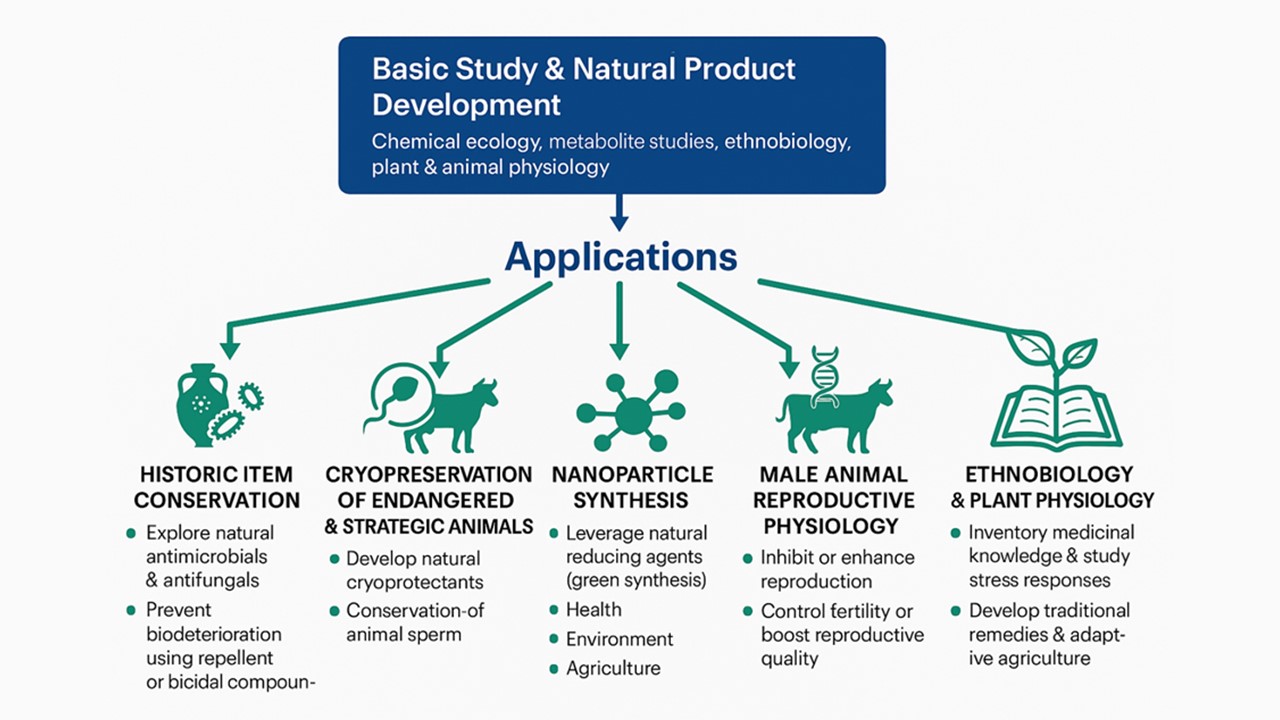
Natural products remain an invaluable source of bioactive compounds with applications in medicine, agriculture, environment, and biotechnology. Despite their potential, The discovery of new natural products has slowed due to conventional and isolated screening methods. This research group proposes an integrative bioprospecting approach that combines chemical ecology, multiomics, ethnobiology, and physiological studies of plants and animals to uncover new bioactive molecules and understand their ecological and physiological roles. Through chemical ecology, the study will elucidate how organisms produce and use secondary metabolites for defense and communication. Multi-omics tools—including genomics, transcriptomics, and metabolomics—will enable comprehensive profiling of biosynthetic pathways. Ethnobiological perspectives will guide compound selection by incorporating traditional knowledge of medicinal species, while physiological analyses will link biochemical profiles to adaptive functions. By uniting these complementary disciplines, this research group aims to accelerate the discovery of natural products and provide scientific validation for their ethnomedicinal uses, ultimately contributing to sustainable resource utilization and the development of new bioactive compounds.
 

Research Roadmap

Short-Term Roadmap (0–5 Years): Building the Foundation

Goal: Establish a strong interdisciplinary framework and develop baseline data, methodologies, and collaborations.

  1. Capacity Building & Infrastructure
    • Establish a Natural Product Bioprospecting Research Unit equipped for metabolomics, chemical profiling (HPLC, GC-MS, LC-MS/MS), and molecular biology (PCR, sequencing, transcriptomics).
    • Develop partnerships with local communities, botanical gardens, and marine research
    • Train researchers and students in multi-omics and chemical ecology
  2. Ethnobiological Documentation
    • Conduct ethnobotanical and ethnozoological surveys focusing on traditionally used medicinal
    • Build a digital database linking ethnobiological knowledge with taxonomic and ecological
  3. Targeted Bioprospecting & Chemical Ecology
    • Select priority species (plants, algae, invertebrates, symbionts) based on traditional use and ecological roles.
    • Study ecological interactions (predation, defense, symbiosis) related to secondary metabolite
  4. Pilot Multi-Omics Studies
    • Apply metabolomics and transcriptomics to identify active biosynthetic pathways in key
    • Begin correlation analysis between genetic expression and compound
  5. Output and Impact
    • Publication of initial compound discoveries and ecological
    • Development of local compound libraries and preliminary bioactivity
    • Strengthened local expertise and international research

Medium-Term Roadmap (5–15 Years): Integration and Innovation

Goal: Integrate ecological, molecular, and bioinformatic data for predictive and applied natural product discovery.

  1. Data Integration & Systems Biology
    • Develop an integrated bioinformatics platform connecting omics data with ecological and ethnobiological information.
    • Apply AI and computational modeling to predict bioactive compound structures and
  2. Functional Characterization
    • Isolate and characterize key bioactive molecules (antioxidant, antimicrobial, anticancer, anti- inflammatory).
    • Conduct preclinical studies and mechanism-of-action
  3. Evolutionary and Ecophysiological Insights
    • Examine how environmental factors (light, salinity, temperature, symbiosis) influence metabolite production.
    • Compare biosynthetic diversity across ecosystems (terrestrial, marine, freshwater).
  4. Collaboration and Application
    • Collaborate with pharmaceutical, nutraceutical, and biotechnology industries for compound
    • Promote bioprospecting ethics and benefit-sharing frameworks with local communities.

Long-Term Roadmap (15–25 Years): Translation and Global Leadership

Goal: Establish the program as a global hub for sustainable bioprospecting, drug discovery, and biodiversity-based innovation.

  1. Sustainable Bioprospecting and Conservation Integration
    • Implement large-scale conservation-based bioprospecting aligned with Access and Benefit- Sharing (ABS) principles under the Nagoya Protocol.
    • Develop in-situ and ex-situ biobanks for key species and their bioactive
  2. Advanced Bioengineering and Synthetic Biology
    • Use synthetic biology to replicate or enhance biosynthetic pathways for scalable compound
    • Develop bioinspired molecules and hybrid compounds with improved pharmacological
  3. Translational Research and Product Development
    • Translate laboratory discoveries into preclinical and clinical development
    • Establish partnerships with biotech startups and pharmaceutical companies for co-
  4. Education and Policy Leadership
    • Launch postgraduate and postdoctoral training programs in integrative bioprospecting and chemical ecology.
    • Contribute to national and international policy frameworks for sustainable bioprospecting and bioeconomy
  5. Expected Impact by Year 25
    • A regional Center of Excellence in Natural Product Bioprospecting and Chemical
    • Contribution to novel drug leads or nutraceuticals derived from local
    • Strengthened biodiversity conservation linked with economic and societal benefits.