
Authors: Arista Sony, Nachrowi Djalal Nachrowi, Djoni Hartono, Lin Yola
Published: 6 Dec 2024
Journal: SSRN: Social Sciences & Humanities Open
DOI: https://dx.doi.org/10.2139/ssrn.5028464
ABSTRACT
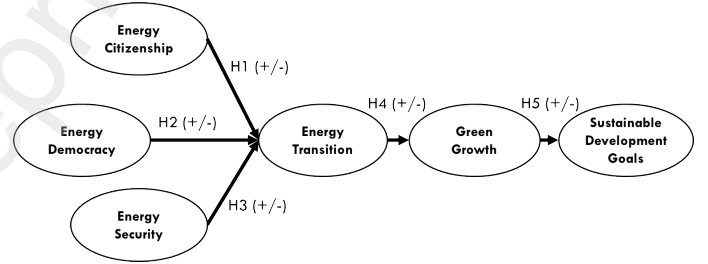
The ten countries of the Association of Southeast Asian Nations have recently experienced a surge in carbon dioxide emissions, leading to adverse effects such as economic losses, rising death numbers, environmental degradation, and a threatened path towards sustainable development. The primary cause of these carbon dioxide emissions is their continuing reliance on primary fossil fuel energy consumption. This study examines the impact of the energy transition on sustainable development by employing the Partial Least Squares Structural Equation Model with 111 indicators using secondary data from 2000 to 2020. A positive direction of energy citizenship, energy democracy, energy security, energy transition, and green growth to sustainable development is empirically shown in this study. Green growth and four other factors play a significant role in helping these countries lower their carbon dioxide emissions by 76.4%, from 1.536 to 362 metric tons of carbon dioxide. These significant factors play a role in pursuing their energy transition and guide the development of green energy policies based on the scientific principles of these energy transition factors to reduce carbon emissions and promote sustainable development efficiently.
Keywords: Energy Citizenship, Energy Democracy, Energy Security, energy transition, Green Growth, sustainable development
Original Link: https://papers.ssrn.com/sol3/papers.cfm?abstract_id=5028464


