Brain–Computer Interface (BCI) is a technology that enables the brain to communicate directly with a computer without the involvement of the peripheral nervous system. BCI works by capturing brain activity signals and translating them into intended actions. This technology has the potential to assist individuals with paralysis or physical disabilities by enabling them to control objects and communicate. One of the most widely developed BCI approaches is based on electroencephalography (EEG) signals due to their non-invasive nature, portability, and relatively low cost.
Imagined Speech refers to an internal mental state in which a person silently articulates words in their mind without producing sound or moving any part of the body. This research proposal focuses on utilizing the cognitive phenomenon of imagined speech within a Brain–Computer Interface to capture neural signals associated with speech imagined by individuals with communication disabilities. These neural signals are processed using Artificial Intelligence and advanced signal processing techniques to reconstruct imagined speech into spoken words.
Decoding imagined speech is a highly complex process. This research focuses on the use of EEG-based BCI for the classification of imagined speech at the alphabet level, rather than full words. It investigates how humans mentally imagine alphabetic characters (imagined speech for alphabets).
Research on Brain–Computer Interface (BCI), particularly imagined speech, is important for several reasons:
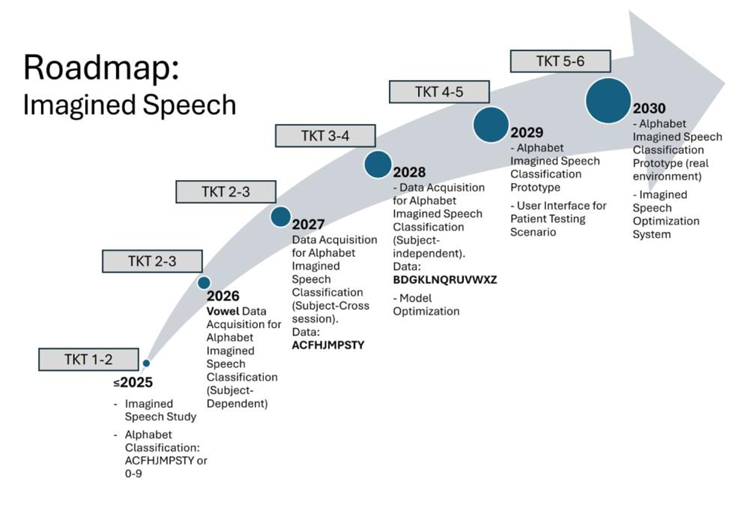
This imagined speech research is multidisciplinary, involving computer science faculty members, undergraduate to doctoral students, neurologists, hospitals, participant subjects, industry partners, and patient trials conducted under the supervision of hospitals and neurologists. An overview of the imagined speech research roadmap is illustrated in Figure 1 below.