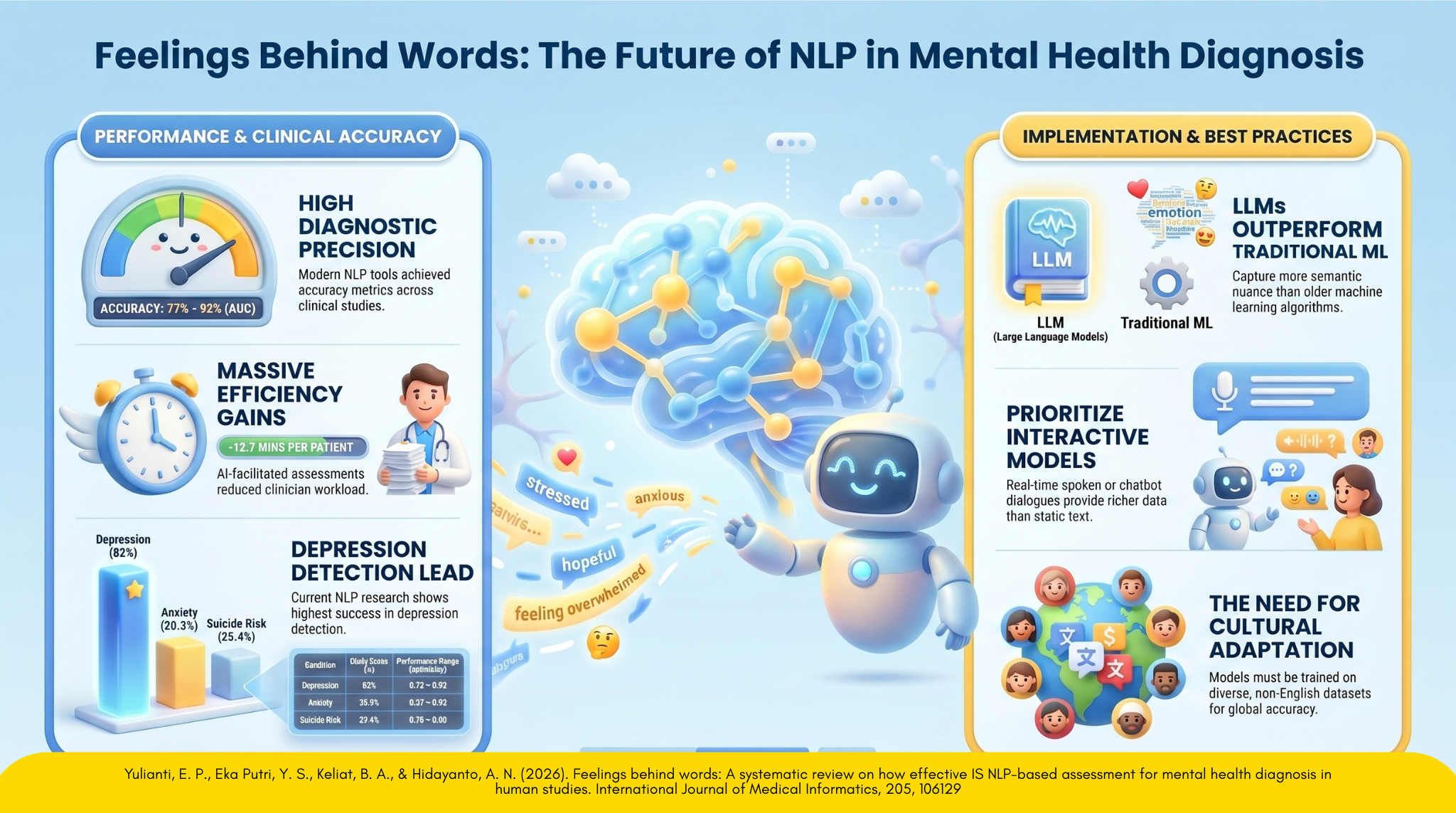
A publication from Mental Health and Psychiatric Nursing Research Cluster members Eka Putri Yulianti, Dr. Yossie Susanti Eka Putri, and Prof. Budi Anna Keliat, co-authored with Prof. Achmad Nizar Hidayanto, is now available in the International Journal of Medical Informatics. The article, “Feelings behind words: A systematic review on how effective IS NLP-based assessment for mental health diagnosis in human studies,” evaluates the diagnostic accuracy, feasibility, and limitations of Natural Language Processing (NLP) tools for mental health assessments.
This systematic review analyzes 17 studies published between 2020 and 2025 to determine the real-world performance of NLP-based Artificial Intelligence (AI) compared to traditional diagnostic methods. The research team examined AI’s ability to identify mental health conditions, particularly depression and anxiety, using text and audio-textual analysis in clinical and community settings.
Key findings demonstrate that Large Language Models (LLMs) consistently outperform traditional machine learning models in detecting depression. The analysis reveals that interactive and spoken assessment models yield excellent diagnostic performance. While NLP tools successfully reduce clinical workload, the study identifies critical gaps in cultural adaptability; models trained on Eurocentric datasets frequently underperform in non-English contexts.
The authors conclude that while NLP-based AI presents substantial promise for clinical integration, operational success demands culturally adaptive models, inclusive cohorts, and diverse real-world training data. The research recommends prioritizing rigorous randomized controlled trials (RCTs) to mitigate biases and ensure equitable deployment across global mental health care environments.