

This research group focuses on the development of advanced spatial analysis methods, predictive modeling, and data-driven geospatial technologies to support evidence-based decision-making. Through innovative research and multidisciplinary collaboration, we contribute to addressing environmental challenges, disaster risk management, and sustainable development in Indonesia.
Indonesia faces complex spatial, environmental, and developmental dynamics that demand precise, integrated, and data-driven solutions. However, several key challenges persist:
Non-Integrated Spatial Data Systems
Spatial data remain fragmented across institutions, stored in varying formats, and often lack standardized frameworks. This limits interoperability, data sharing, and comprehensive territorial analysis.
Urgent Need for More Precise Regional Analysis
Many planning and policy decisions still rely on coarse-resolution datasets and conventional analytical approaches, reducing the accuracy of spatial assessment, forecasting, and evidence-based decision-making.
Limited Human Resource Capacity in Advanced Geospatial Technologies
There is a shortage of professionals with interdisciplinary expertise in GIS, remote sensing, artificial intelligence, and spatial data science, constraining innovation and large-scale implementation.
Addressing these interconnected challenges is essential to strengthening data-driven territorial governance and advancing sustainable development outcomes.
We exist to bridge critical gaps between fragmented spatial data systems, limited analytical precision, and constrained human resource capacity. Through innovation and interdisciplinary collaboration, we aim to transform geospatial research into impactful and operational solutions.
Our research group integrates spatial science, advanced geospatial analytics, and computational modeling to generate robust, scalable, and evidence-based frameworks. Specifically, we focus on:

This research area focuses on developing interoperable spatial data systems and analytical frameworks to support comprehensive territorial analysis. The work emphasizes data standardization, multi-source integration, and scalable spatial information systems.
Recent research topics include:

This research area advances satellite-based environmental monitoring and high-resolution spatial analysis. We develop methods for extracting accurate environmental indicators using image processing and geospatial analytics.
Recent research topics include:

This research area applies artificial intelligence, machine learning, and predictive modeling to support risk assessment and sustainable planning. The focus is on transforming spatial data into reliable forecasting and analytical tools.
Recent research topics include:

The Shallow Water Mapper (SWM) is Indonesia’s first Satellite Derived Bathymetry (SDB) software, developed under the leadership of our researcher, Dr. Eng. Masita Dwi Mandini Manessa, M.Eng., to deliver efficient and cost-effective shallow-water mapping through the use of satellite imagery and machine learning.
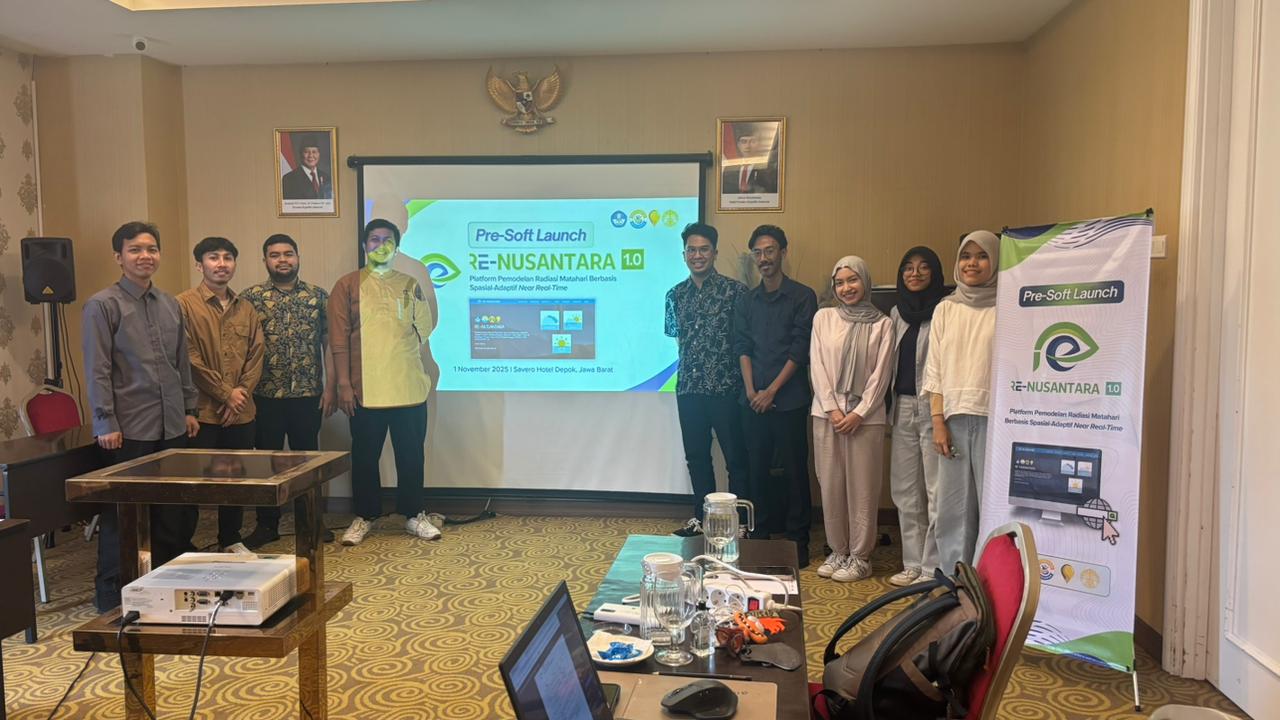
RE-NUSANTARA 1.0 is a solar radiation monitoring platform developed through a project involving researchers from the GEORI research cluster, including Prof. Dr. Muhammad Dimyati, M.Sc. as Project Leader and Pranda Mulya Putra Garniwa, Ph.D. as a team member. The platform provides estimates of Global Horizontal Irradiance (GHI), Clear-Sky Global Horizontal Irradiance (GHIC), and Cloud Index (CI) using a semi-empirical model enhanced through site adaptation, regression, and machine learning.