
ABSTRACT: The proliferation of Information Technology (IT) has significantly accelerated the deployment
of numerous services in different fields, including education. Assessing e-learning lecturers’ and students’
satisfaction has become essential for improving the quality of teaching and learning processes. Most of the
previous approaches have introduced several feature weighting models that represent sentiment or emotion
analysis by combining Word2Vec with TF-IDF or TF-IWF. However, these models do not consider two
important features: Word Frequency (WF) and Document Frequency (DF) and fail to address varying levels
of users’ satisfaction. Additionally, integrating sentiment and emotion information from extracted opinions
in e-learning systems has received limited attention and still requires further improvement. To overcome
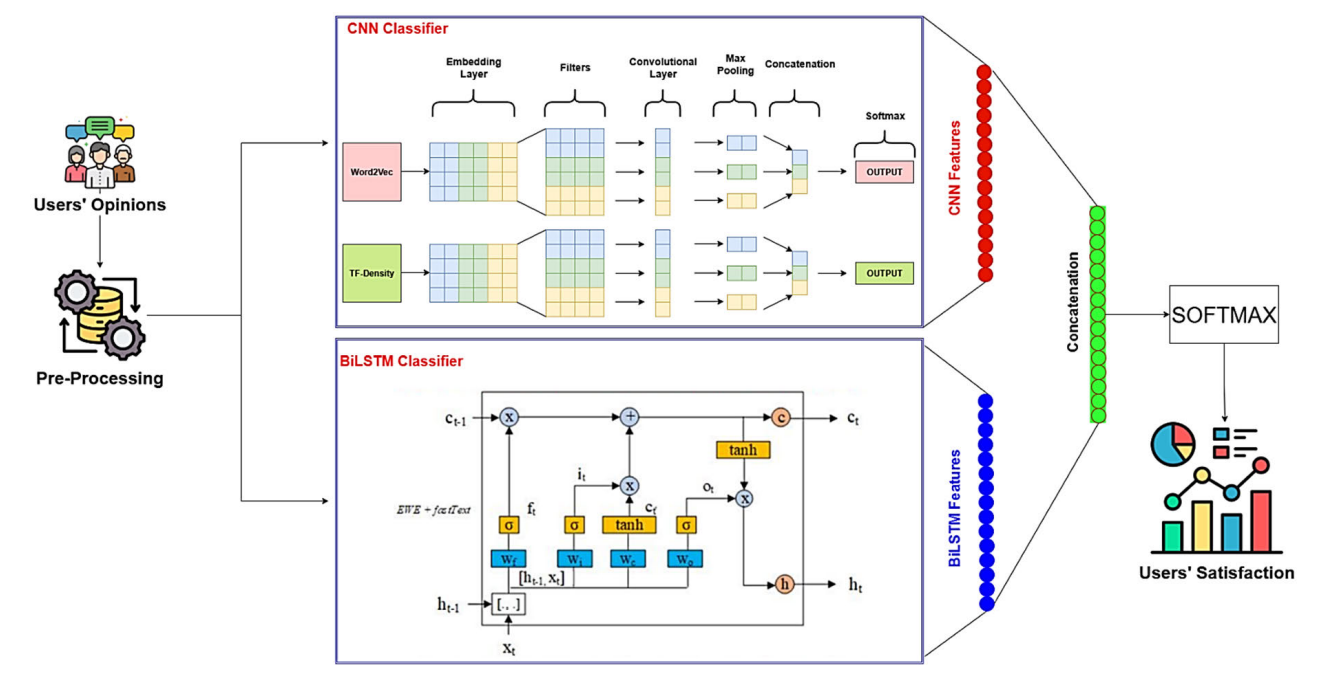
these limitations, this study presents Sentiment and Emotion Multi-task Analysis Recognition (SEMAR),
a new multi-task term-weighting strategy that departs from conventional embedding fusion. SEMAR assigns
multiple, context-aware weights to every term and integrates TF-Density, Word2Vec, EWE, and fastText in
a dual CNN+BiLSTM architecture, enabling joint capture of statistical, semantic, and affective patterns.
Extensive experiments on six heterogeneous datasets show that SEMAR consistently delivers significant
performance gains, achieving an average F1-score of 91.82 % and surpassing all baselines by a large margin.
These findings indicate that employing multi-task term weighting together with a dual-branch deep learning
architecture provides a substantial step forward for analyzing sentiment and emotion-driven e-learning
satisfaction, rather than simply merging pre-existing methods.
INDEX TERMS: E-learning, users’ satisfaction, sentiment and emotion, term weighting, deep neural
network.
IEEE Access
Digital Object Identifier 10.1109/ACCESS.2025.3627657