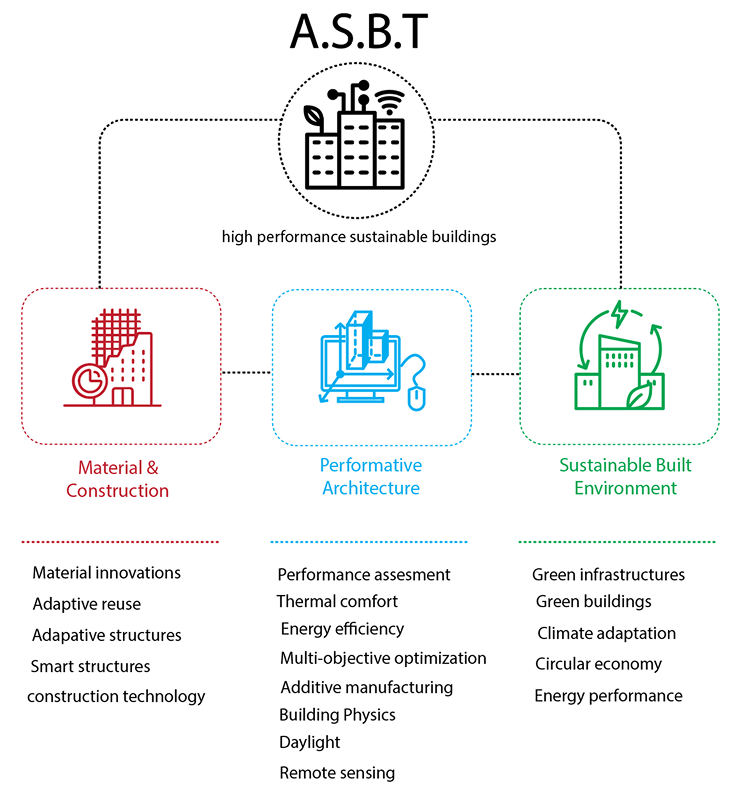
The Architectural Sciences and Building Technology (ASBT) Research Cluster is a group under the Department of Architecture, Faculty of Engineering, Universitas Indonesia, formalized in 2025 through the Dean’s Decree (SK Dekan FTUI no 1565/SK/D/FTUI/2025). ASBT is dedicated to reducing the environmental, social, and economic impacts of buildings while supporting research aligned with the Sustainable Development Goals (SDGs).
Our work focuses on building occupant comfort, intelligent building systems, renewable energy integration, sustainable built environments, material innovation, and energy conservation. Through interdisciplinary research and technological innovation, we aim to advance climate-responsive, energy-efficient, and adaptive architecture suited to tropical contexts.
To become a leading platform for advancing high-performance and sustainable buildings through the integration of architectural design, building engineering, and digital innovation.
To address urgent challenges in the built environment—urbanization, climate change, and technological transformation—through measurable and performance-based design approaches.
To advance interdisciplinary research that connects architecture, construction technology, computational methods, and material innovation.
To promote the adoption of circular material strategies and data-informed decision-support systems in building practice.
To strengthen collaboration between academia, industry, and government in accelerating Indonesia’s transition toward low-carbon, resilient built environments.
To support education and capacity-building that encourage evidence-based and environmentally responsible design practices.

Exploring innovative materials and construction systems to create adaptive, efficient, and sustainable buildings.
Focus areas include:
Advancing performance-based design through computational methods and scientific analysis to balance technical efficiency and architectural quality.
Focus areas include:
Maximizing resource efficiency and minimizing environmental impact at building and urban scales.
Focus areas include: